

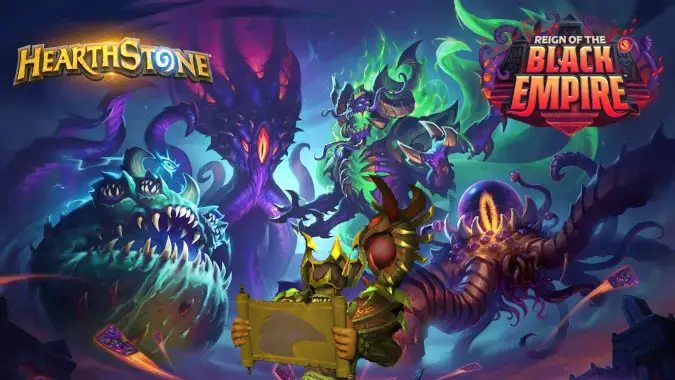
With a few weeks of the new Reign of the Black Empire expansion under their belts, Hearthstone players have been able to get a feel for the new cards and mechanics. Picking apart the story underneath and its implications for the wider Warcraft universe takes a little bit more effort.
We’ll need to keep in mind that Hearthstone is not canon to World of Warcraft, and is instead a fun series of stories, “what-ifs,” and straight-up impossibilities. However, there have been times when things first seen in Hearthstone later made their way into WoW. So, with a tinfoil hat and a few grains of salt, let’s wade into the lore implications of Reign of the Black Empire.
The expansion itself takes place so far in Azeroth’s past that we don’t have a date other than “a very long time ago.” After the Old Gods arrived on Azeroth, they subdued the elemental lords and battled amongst each other for another undetermined amount of time. This dark period is known as the Black Empire, and the card set occurs just as the Titans arrive on the planet to smash the empire to bits.
It’s always nice to see a familiar set of tentacles
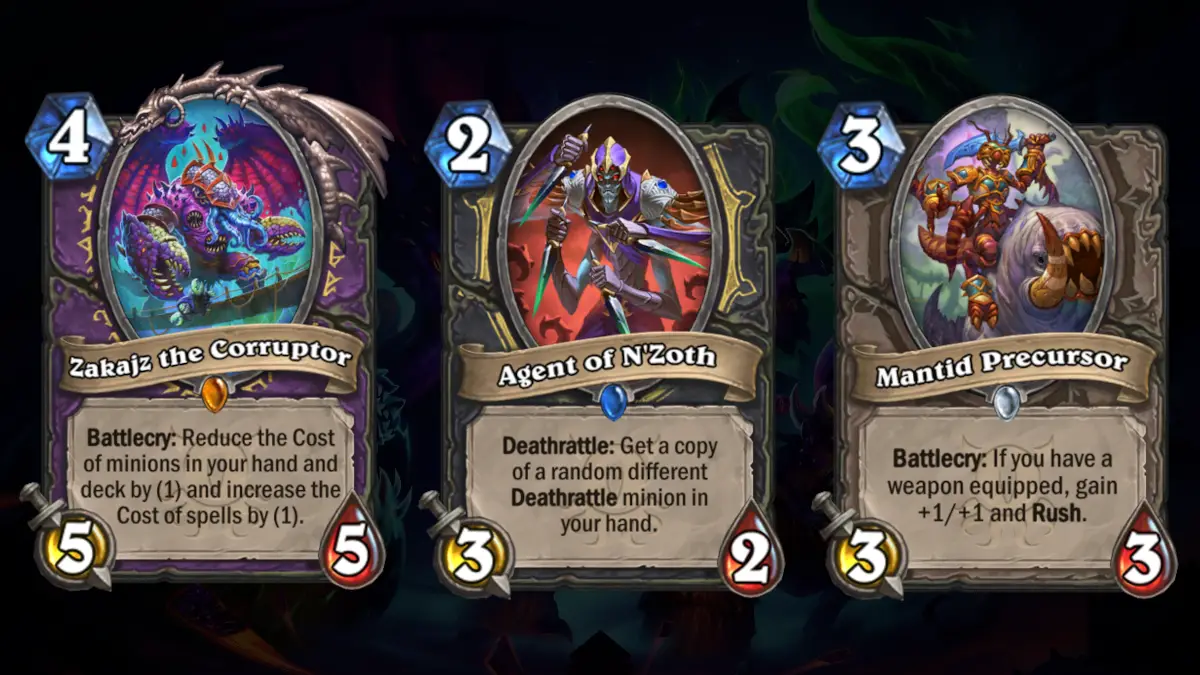
Many of the cards in Reign of the Black Empire are exactly what you’d expect to see: a wide variety of servants of the Old Gods. We’ve got Aqir of all stripes, from lowly Swarmers to the more-evolved Shadowcrafters. The same is true of the other beings born of the flesh of the Old Gods, the N’raqi, with simple nameless spellcasters as well as top-tier Old God lieutenants like Zakajz the Corrupter.
One interesting inclusion is Mantid Precursor, suggesting that the Mantid began differentiating from other Aqir sooner than the Troll-Aqir War. I am fascinated by the inclusion of an Ascended Nerubian, Agent of N’Zoth. We spent much of The War Within learning how Xal’atath used the Black Blood to create a vanguard of elite Nerubians, and confirmation that N’Zoth was doing the same thing eons before comes as little surprise. It was his blood, after all, that seems to have been the catalyst of this forced evolution in Azj-kahet.
On the other side of the battleground on Team Titan-forged, we also have a plethora of garden-variety troops. Earthen, Vrykul, Anubisaths, Mechagnomes, and Refti all appear much as we’d expect from encountering them on Azeroth millennia later. If the Mogu Warmaster art looks a bit strange, that’s because it depicts a rather unique individual: Lu’lin, one of the Twin Empyreans in the Throne of Thunder created by Lei Shen himself.
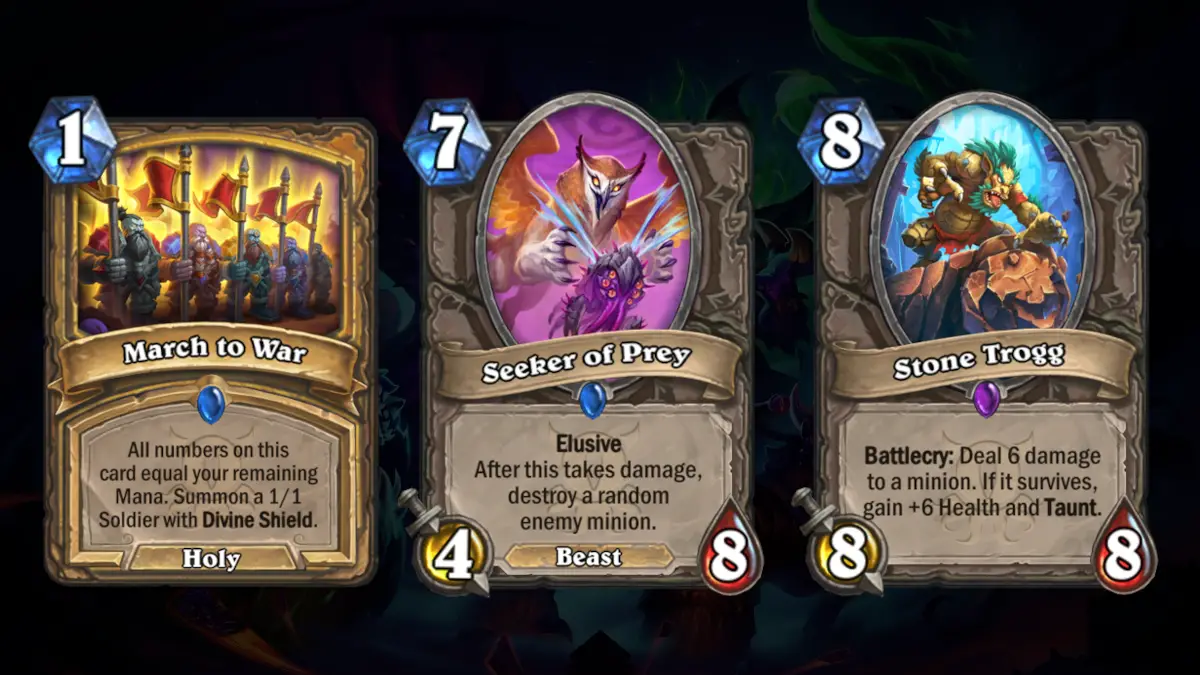
Priest mains from Legion will recognize the owl-faced creature in Seeker of Prey as their class hall mount. These light-infused flying feathered friends seem to have been hand-selected by the Keepers to serve as personal steeds. You can also pop some Stone Troggs onto your board, which have a hilarious flavor text referencing the fact that they were discarded prototypes of later successful Titan-forged creations.
While a bit jarring, it’s also perfectly rational (and pretty cool) that some of the items we’ve only recently acquired in World of Warcraft have existed on Azeroth for thousands of years. Running enough Delves in The War Within Season 2 (or saving up enough Undercoin afterwards) would reward you with an OC91 Chariot, which have evidently been used by Goblins since the war against the Old Gods to blast tentacles from above. I’m still working on obtaining my first Mechacycle, which have apparently been careening around Azeroth piloted by Mechagnomes since the distant past.
Finally, there are a decent number of Azerothian critters and beings depicted in Reign of the Black Empire. The Voidwing Dragonhawk was the Midnight special edition mount, but it also seems to be a Team Old God trick to summon them from the sky. Are these creatures native to the planet in their void state, or did some N’raqi casters corrupt them into shadow, followed some thousands of years later with Team Umbric repeating the feat?
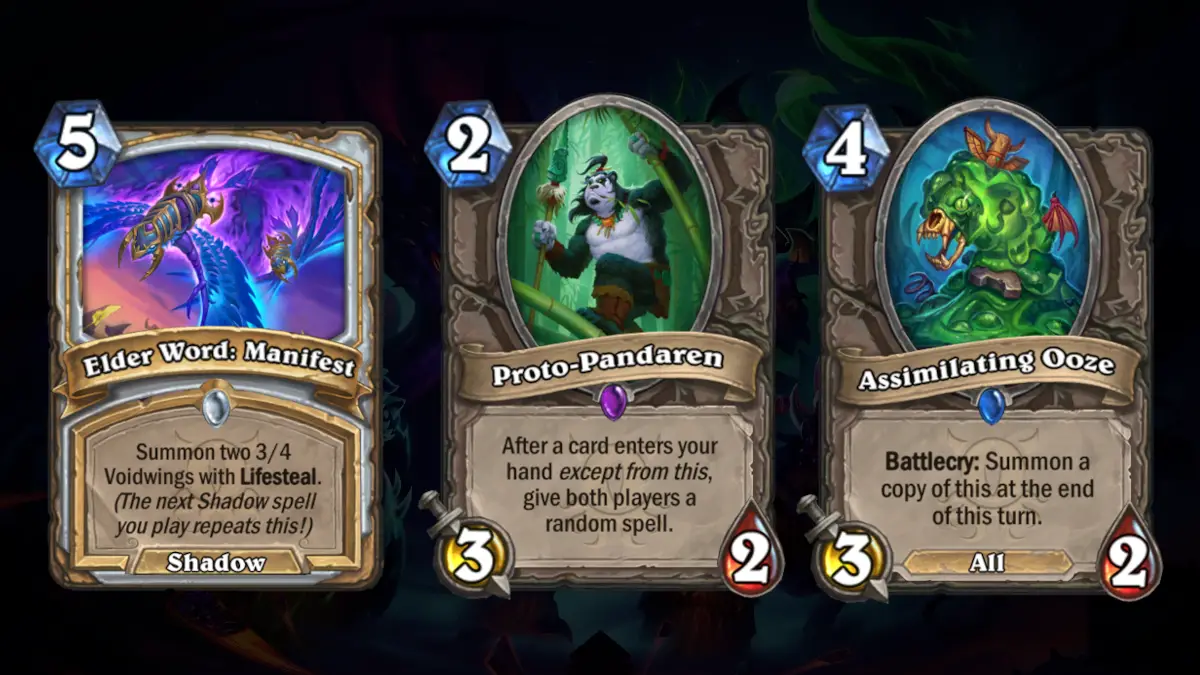
One obvious talking point is the Proto-Pandaren. While the origins of the Pandaren race remain shrouded in mystery, this lithe bamboo climber gives us an interesting peek further back into their evolution. The decoded flavor text and monkey-like appearance suggest a shared lineage with Hozen. Perhaps we will learn more when the Monk class becomes available with 2027’s first Hearthstone expansion.
Another race that has a mysterious yet far-reaching history on Azeroth is the Tauren. While they (and their progenitors, the Yaungol) are absent from the art of Reign of the Black Empire, there is a totem in Assimilating Ooze that wouldn’t look out of place in modern Thunder Bluff. Although that particular slime has also absorbed a pirate hook-hand, so all lore-determining bets are off.
How did you get here?
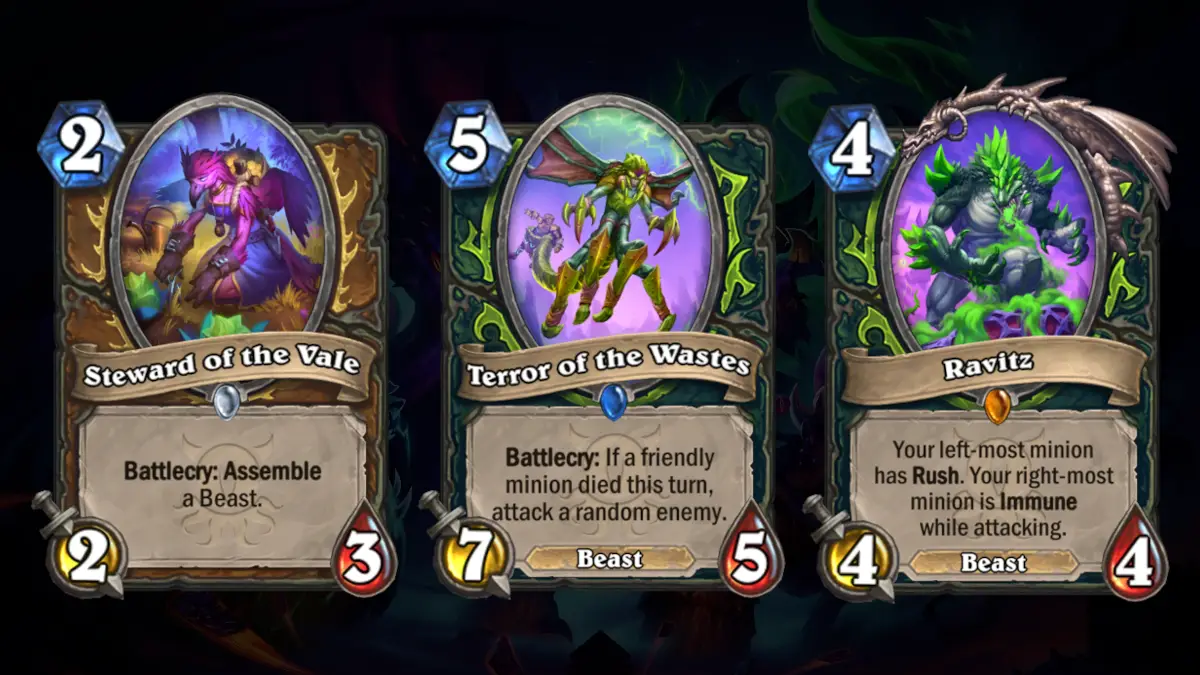
As always, there are cards in the Hearthstone set that are either imaginative storytelling or canon-disrupting revelations. For example, is that an Arakkoa in Steward of the Vale? How would an individual from Draenor make their way to Azeroth eons before the opening of the Dark Portal? Perhaps Aggramar sent some Arrakoa across the cosmos to help with flower arranging in the Vale of the Eternal Blossoms.
In this card set we’ve got an ultradon, a harrower, and shredclaws. Is Midnight leaking into Hearthstone, or is Xal’atath’s summoning ritual not the first time that Voidstorm (previously Predacea) has had a void-empowered run-in with Azeroth? The skies above K’aresh are ruled by voidscythes, and Terror of the Wastes suggests that they aren’t native but rather brought there by Dimensius and his void forces due to their presence on Azeroth long ago.
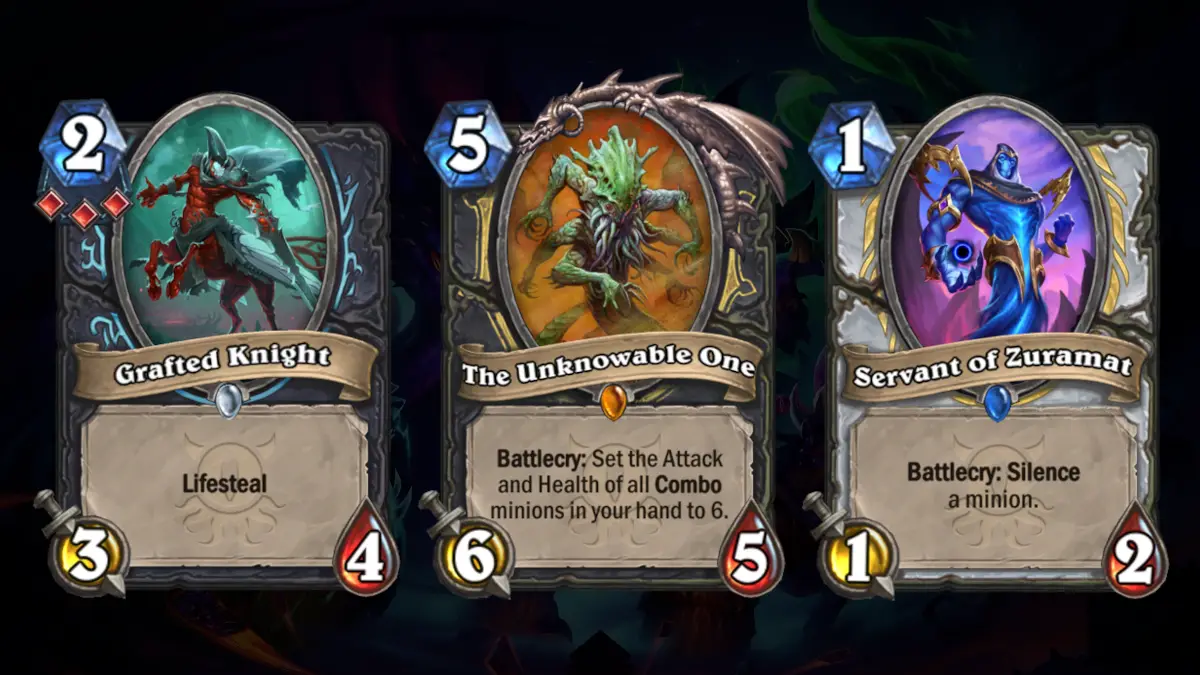
There are several entities that I am not able to identify, which is always pretty exciting for such an expansive but not-fully-explored universe. For example, what exactly is Grafted Knight? It seems like a bit of a Centaur-adjacent G’huun offspring. The tentacled horror from Mismatcher isn’t on any of my N’raqi family tree tapestries. And just what is Zerontu? I was going to suggest that it was some sort of ascended, muscle-bound, two-head Ogre before I spotted at least three additional heads.
The Unknowable One is a freakish legendary card depicting a six-armed monstrosity that doesn’t quite fit within Warcraft’s taxonomy. The flavor text suggests that it was created as a sort of weapon by C’Thun to slay the non-canon exclusive-to-Hearthstone Keeper Amitut. This text also cryptically suggests that it would rise again to its master’s whispers.
Finally, the presence of Domanaar at the time of the Black Empire is fascinating. Given that Spawn of Y’Shaarj features the Old God appearing to summon one, I would wager that the Old Gods of Reign of the Black Empire can summon void beings from across the cosmos to do their bidding. At least, that would make for a good explanation in the Hearthstone tavern.
I learned something today
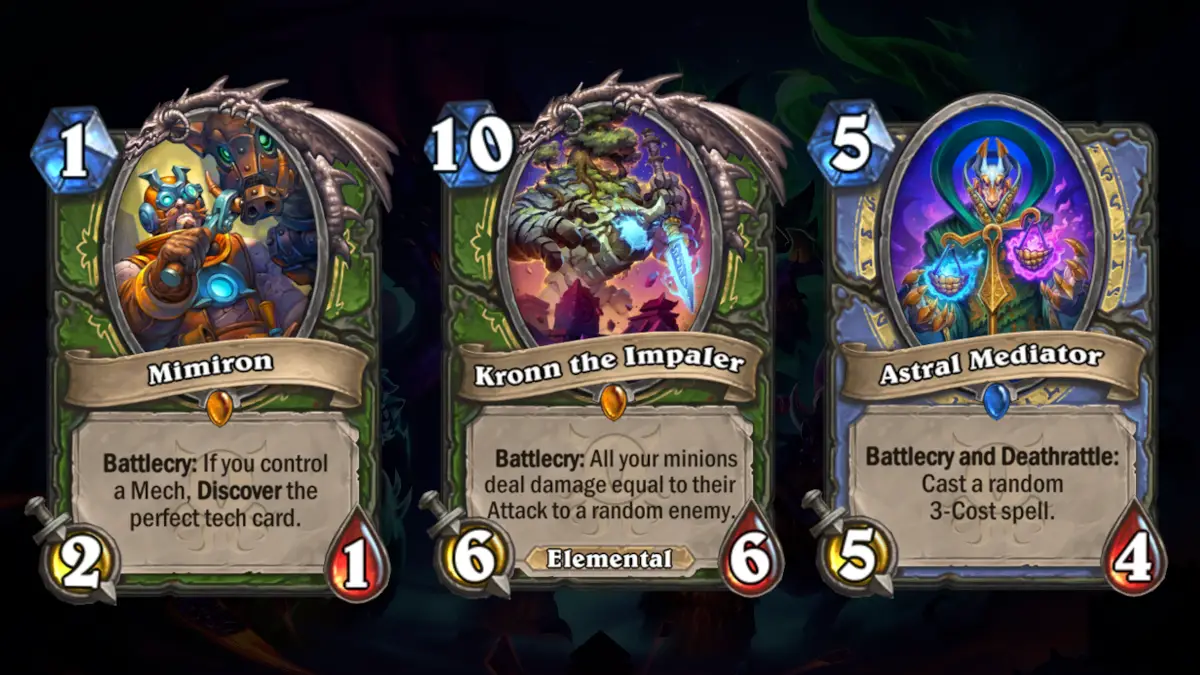
Did you know that Mimiron wasn’t always an enormous Mechagnome? I didn’t, despite knocking some sense into his corrupted noggin countless times in Ulduar. He originally was a buff, mustachioed Keeper who fell to Yogg-Saron’s plot but managed to upload his consciousness to the nearest clockwork servant.
Perhaps my favorite throwback card is Kronn the Impaler. I believe this is the first depiction of the stone giant we’ve ever seen, and it only comes 22 years after we first stumbled across his enormous weapon embedded in the skull of his enemy at The Master’s Glaive in Darkshore. The flavor text explains how Y’Shaarj managed to orchestrate his demise via elemental assault.
According to known lore, Azeroth was inhabited only by elementals before the Old Gods showed up. If that’s the case, what are Kith’ix and his big, red servant smashing in Ritual of Conquest? Are those Earthen hands reaching out of the cages, and is that proto-Dornogal before they had a proper run at their own architecture? A similar location can be seen in Domain of Yogg-Saron. I’d need a second tinfoil hat to speculate on who could have been already living on Azeroth at the time the Old Gods first descended from the skies.
My final question focuses on Astral Mediator. Its appearance resembles that of a Titan-forged Anubisath, so it could simply be a very order-minded creation bent on fairness. The flavor text, however, suggests that the thing the mediator is overseeing is the conflict between the Old Gods and Titans. Could this be some higher being of the cosmos whose form was imitated by the Titans when creating the Anubisaths?