Diablo 4’s new Warlock comes with the Lord of Hatred expansion in a blaze of abyssal shadows (and an army of demons)
 @lizexmachina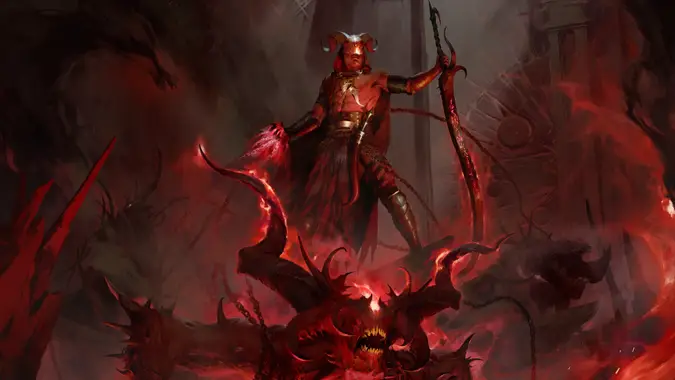
The Warlock joins the Diablo 4 campfire with the Lord of Hatred expansion global launch on April 28, 2026, and we at Blizzard Watch had an opportunity to test-drive the new class! And oh boy, I did not expect to enjoy a class described as an edgelord and yet, here I am, about to gush over how much of a joy it was to play. The Warlock is ready for your dark gaming desires, whether you want to summon an absolute slew of demonic minions leashed to your will, drown enemies in abyssal darkness, or just (hell)firebomb the heck out of Sanctuary. Read on for my initial thoughts on Diablo 4’s new Warlock class and why you may want to give it a try with the release of Lord of Hatred (and never fear, this review remains free of story spoilers).
The Warlock is the second class in the one-two combination release coming with Lord of Hatred, following the Paladin which dropped immediately following the expansion’s announcement at the 2025 Game Awards. In the press review Discord, Blizzard hosted an AMA with familiar team faces Zaven Harountian (Associate Game Director), Colin Finer (Associate Director for Game Design), and Barry Morales (Associate Production Director). When asked about the class design process, Zaven stated that “everything in Lord of Hatred was built around the central tension of Angels and demons… and we see classes as a key part of expressing this.” The Warlock is literally the demonic counter to the light of the Paladin, “something new… to look forward to as well.”
What to know about the new Warlock class
From a functional standpoint, the Warlock is a hybrid caster/summoner class leveraging two resources, Wrath and Dominance (similar to Diablo 3‘s Demon Hunter). Wrath is the quicker regen resource used for things like your Core skills, while Dominance is leveraged by the bigger impact casts and regenerates a little slower. I found this resource system tied well into the “smaller, constant damage” followed by “big, explosive occurrences” playstyle highlighted in Blizzard’s Warlock trailers so far.
The Warlock has three focus areas: Hellfire, Abyss, and Demonology. Hellfire is exactly what it sounds like on the label — think small pools of lava to flaming fissures, fiery demon skulls and the caster’s Ultimate transformation into a powerful, fiery Demonform. Abyss is the shadow-focused skillset; where Hellfire is all burning damage, Abyss is damage and control. You’re whittling your enemies down with Hex, controlling their position with shadowy chains (and your own with a step through the nether), unleashing a dark terror from the depths of Hell itself to melt your enemies.
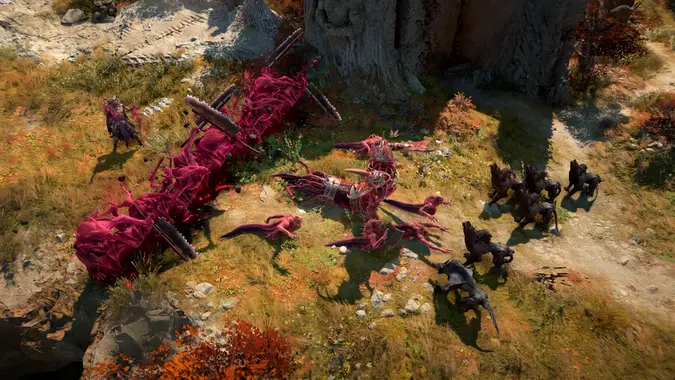
Demonology deserves its own highlight because it truly drives the entire class, even if you choose not to focus on it. From your basic summoning of a Fallen Lunatic, to bombarding the ground with demons or binding them together in a wall to block enemies, demons are the very underpinning of a warlock’s powers. I had a successful gameplay experience without them for at least 40 levels, but they’re still there, lurking in your skills.
Most of my play was focused on Hellfire and Abyss skills, although I definitely got into some of the Demonology abilities. Wall of Agony was a consistent standby that proved a great example of using summons for battlefield management — the demons fused together both actively block enemies and deal damage. The Encircle modifier kept me in a formation of demons, protecting me with increased damage reduction and swapping Dominance cost for a cooldown.
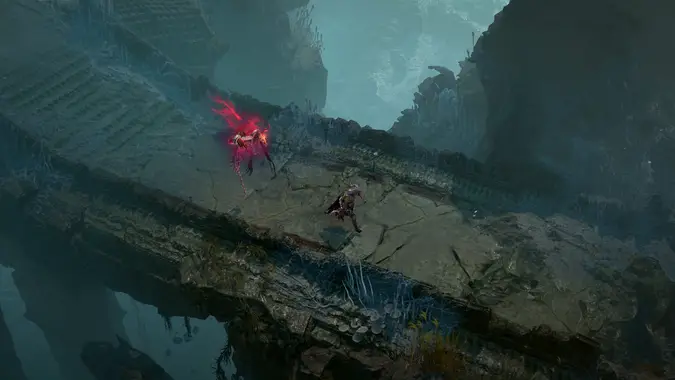
I ultimately combined Wall of Agony with two of my favorite skills, Dark Prison and Blazing Scream. I used Dark Prison with Chain Aura applied — this skill modifier turned it into a Hellfire skill that created an aura of fire chains around me for damage reduction and enemy slowing, which felt so good when racing through packs. Meanwhile, Blazing Scream with the Abyssal Oppression modifier became an Abyss Recast Summon (quite a mouthful), that I drove through enemies like a shadowy skull lawnmower.
Warlock class system: Soul Shards
Soul Shards are the Warlock class system. You pick a primary Soul Shard (from four options) and an associated secondary fragments (from three options) to buff your desired playstyle. Your selected Soul Shard also opens up an extra Greater Demon to summon (if you choose to use it). These feel very similar to the Druid or Spiritborn systems, where you select primary and secondary choices for passive power-ups, but with an additional Summoning skill component unlocked based on your selection of primary that you can choose to put on your cast bar.
The four Soul Shards align with different playstyles:
- Legion is your dedicated Demonology shard, passively boosting your Lesser Demon skills every cast of a Greater Demon skill. Its Summoned Greater Demon is Ae’gron, and the shard fragments involve spawning lesser demons (Spawn), sacrificing parts of your demon army (Sacrificial), or focus fire on eviscerated, bleeding enemies (Evisceration).
- Vanguard is a bit of a hybrid, focusing more around your Demonform and its associated Archfiend skills for its passive. Its Summoned Greater Demon is Abodian, and its first fragment increases Abodian’s powers (Hellguard), while the other two extends the duration of Hellfire Demonology Summons with a damage booster (Warden) and leverage the new Volatile keyword in Demonform to emanate fire from your transformed self (Inferno).
- Mastermind is entirely Abyss focused, with a passive that ties together your Recast Skills to Shadowform for a damage and movement speed boost. Its Summoned Greater Demon is Laalish, and its fragments have Laalish weakening and executing enemies when summoned (Unfathomable), Recast skills places Hexes on enemies (Blasphemous), and increasing the damage of (non-Soul Shard) Abyss Greater Demons (Subjugation).
- Ritualist is tied into the Occult keyword, making it our second hybrid shard and passively increasing Occult skill damage for stacks of Overpower. Its Summoned Greater Demon is Valloch, and its fragments stack Hex to a max of four to increase Occult Abyss skill damage (Abyssal), empowering Occult Hellfire skills and improving Volatility (Scorching), or combining the two to have Occult Hellfire skills consume stacks of Hex to increase damage while Volatility empowers Occult Abyss skills (Twisted).
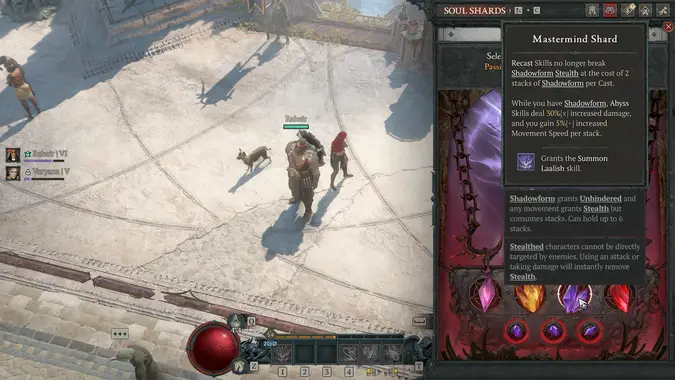
I engaged with two of these shards — Mastermind and Ritualist — granting the Laalish and Vollach summons. Laalish’s focus around the shadowy Abyss gave me a passive way to apply Hex through the Blasphemous shard fragment, letting me remove a Basic skill off my bar (made easier with the new skill tree changes) in favor of even more battlefield control skills. Including the Command Laalish skill on my bar gave me a consist method of applying Vulnerable to enemies. I’m not going to lie, this combination went hard and I had trouble moving away from it!
But I still gave Ritualist some love, and with Command Valloch on my bar I never ran out of Wrath. I combined the Abyssal fragment with Sigil of Subversion (for Hex casts) and Umbral Chains. The two together were powered up by Abyssal both boosting my Hex stacks to max, with a bonus stack for those two Occult Abyss skills. The constant damage echoes when I applied this to groups resulted in some incredible passive damage that required no extra effort from me.
Final thoughts on the Warlock class
The Warlock was an absolute blast to test drive as part of our review period. I was never bored or frustrated, and I felt like I got to try a diverse array of skill combinations. I glibly described the class as “Warlock: What if your Diablo 4 Sorcerer and Necromancer had a baby, and that baby listened to a lot of Black Sabbath” but that is genuinely the vibe. A little dark caster, a little summoner, and a lot of heavy metal. Having played the Paladin for the last two seasons, I am confident in saying that Zaven is right, and they are complete opposites.
I was also amazed that, as a caster, I hardly ever felt squishy. That’s something I struggled with as both Sorcerer and Necromancer in the base game — until you built up those defensive skills or passives, you could go splat at the drop of a hat. Because this was a new class, I was playing it safe, but by level 30 I was confidently progressing from Normal to Hard, capping the storyline on Expert with a few deaths. Like any new class, you need to get a feel for both the skills and the resource system, but once you do, the world is your oyster to devour with your shadowy, fiery legions.
In short: if you want to buy into the class fantasy of leveraging dark powers for battlefield control, create big, fiery explosions, or turn the armies of the Burning Hells against themselves with your demonic summons — the Warlock is absolutely for you.
If you are dying to play the Warlock class, check out Blizzard’s “The Lost & The Damned” motion comic (included above). This short video gives a glimpse as to why these Vizjerei descendants have remained in hiding for centuries. And chin up — both the Warlock and Lord of Hatred expansion will be here soon!
Please consider supporting our Patreon!
Join the Discussion
Blizzard Watch is a safe space for all readers. By leaving comments on this site you agree to follow our commenting and community guidelines.